

TL;DR
I don’t worry about how to maintain my language skills. Languages fade, but they don’t disappear. With a few weeks of focused listening and reading, you can quickly reactivate what you’ve already built and regain your confidence.
I speak 21 languages. How do I maintain my language skills? In short, I don’t really worry about it. I cannot realistically maintain 21 languages, but I’m confident that I can rebuild my skills when necessary. A polyglot understands that languages fade, but don’t disappear.
Accept That Skills Fade
Some of my languages require less maintenance than others. My French and Japanese, for example, are always ready to go. I’ve lived in France for three years and Japan for nine. I’ve found that my skills in these languages don’t rust very quickly.
However, you can’t actively maintain every language forever. I have a decently long list of languages that I spoke well, but have not maintained: Romanian, Greek, Polish, Czech, Korean, Portuguese.
Just recently, I watched a movie in Polish with my wife. It was quite difficult to follow, especially the more colloquial, informal conversations. Does this mean that I’ve failed as a Polish learner? Are my Polish skills lost forever? No.
If I need to improve my Polish, I still have that knowledge. I accept that my skills in this language are currently dormant, but I’m not starting from zero.
Languages Come Back Faster the Second Time
Think of a language as a seed that can always be watered. A couple years ago, I challenged myself to post more videos in Portuguese. I discovered rather quickly that my Portuguese was not up to the task.
To improve my Portuguese, I needed to spend some time reactivating prior knowledge, not starting from scratch. Continuing with the metaphor, a few weeks of listening and reading is the equivalent of watering a seed, bringing it back to life.
The language skills come back quickly. When it comes down to it, this is simply a more extreme case of forgetting and relearning.
The Best Way to Maintain Language Skills: Input
Focus on Comprehension
Listening and reading are the fastest ways to refresh a language. When targeting Portuguese, I loaded up on Brazilian podcasts. Immerse, input-based learning is how we acquire languages. Polyglots use this same approach to maintain (or revive) language skills.
Podcasts, videos, and books reintroduce your brain to the language and rebuild fluency. Rather quickly, you’ll reach or surpass the skill level that you had before.
Speaking Is Different
To speak well, you must speak regularly. Targeted speaking practice, supplemented with consistent reading and listening, will help you build spoken fluency. Before a trip or a conference, I’ll place a stronger emphasis on speaking than I would if learning a language from scratch.
How I Maintain My Language Skills on LingQ
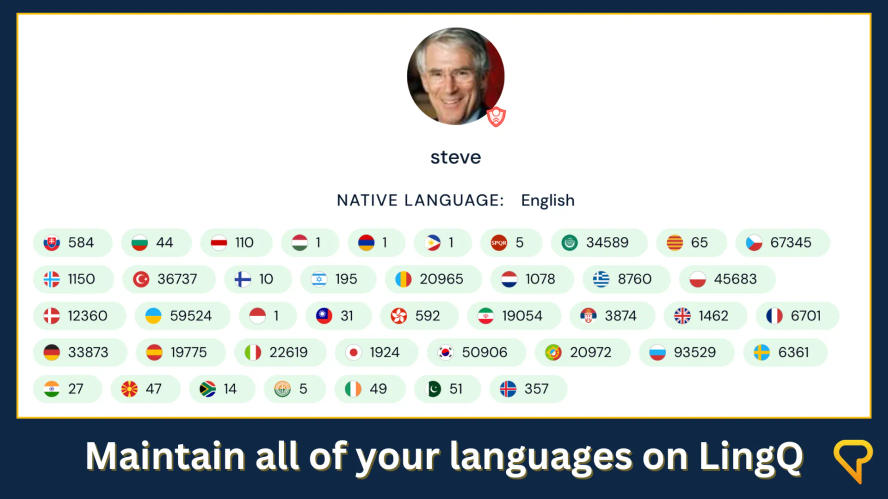
Most of my listening and reading happens on LingQ. It’s a more practical way to load of on comprehensible input. On LingQ, I’m able to:
- Understand more with one-click translations.
- Track my known words and study habits.
- Review texts sentence-by-sentence.
If I need to revive a language that I haven’t engaged with in awhile, I often start with the Mini Stories for quick, structured input before diving back into more authentic content. Overall, LingQ smoothens out the process of reading and listening, allowing me to focus on reacquainting myself with the language.
Be Less Critical of Yourself
Once you reach a certain number of languages, it becomes unsustainable to maintain all of them consistently. It can be frustrating to notice a loss of fluidity in another language, but feeling rusty doesn’t mean that those skills are lost.
We judge our level more harshly than native speakers do. I’ve found that, when speaking German or Romanian, I was much more critical of myself than others. We tend to fixate on what we’ve momentarily lost while others praise what we’re still able to do.
Trust that, after some exposure, confidence and fluidity will return.

Conclusion
You don’t need to constantly maintain every language. Let them rest. Follow your curiosity and pursue other languages. For most of us, there’s no reason to maintain your skills in all of your languages at all times.
When you need a language, whether for work or travel, re-engage through listening, reading and a boost in conversation practice. What you built is still there. It just needs some brushing up.
FAQs
1. Do you need to actively maintain every language you’ve learned?
No. Especially after a certain number, it’s unrealistic. Don’t feel hindered by your languages. If you need to invest your time elsewhere, trust that those skills can be quickly rebuilt at a later time.
2. How quickly do language skills come back after a break?
As you read and listen, you’re mostly reactivating previous knowledge instead of acquiring completely new information. I normally need several weeks to feel familiar with the language again.
3. What’s the best way to maintain language skills?
Listen and read extensively. That’s how we acquire languages in the first place, and it’s how we refresh them.
4. Is speaking necessary to maintain fluency?
If you want to speak well, you need to speak regularly. Input maintains comprehension, but active fluency requires active use.
5. What if I feel like I’ve lost the language?
Rustiness isn’t loss. With consistent exposure and targeted practice, your confidence and fluidity should return quickly.


