

TL;DR
Independent lifelong learning is the key to success in a rapidly changing world. Instead of relying entirely on formal institutions, effective learners independently explore their curiosities in a self-structured, disciplined manner. Consistent learning habits with meaningful content build sustainable lifelong learning habits.
______________
Independent lifelong learning is the most important issue in education today. More than class size, teacher credentials, or the latest teaching methods, developing independent learning habits should be the top priority.
Why Independent Lifelong Learning Matters
Governments are spending larger amounts of money on education, but the results are disappointing. As pointed out in this article, the United States education budget has grown 350% after inflation since 1970, but outcomes have not improved.
Most schools cost too much and deliver too little, especially in an era of constant technological change. Working people need to constantly update their skills and adapt. Learning cannot be limited to school years. Lifelong learning has become essential.
The most effective learners are independent. They’re not passive recipients of information, but active knowledge seekers capable of exploring new ideas and adapting their learning methods.

Forced Learning Is Ineffective
Forcing a curriculum on passive or unwilling learners yields poor results. Teachers know that internal motivation plays a huge role in the success of the student. Curiosity drives learning.
An independent, motivated learner asks questions, explores topics, and constantly seeks a deeper understanding.
The world is becoming more conducive to independent lifelong learning. Today, learners have access to:
- Free lectures and courses from universities like MIT and Stanford
- Educational platforms and apps such as Khan Academy
- Podcasts and videos
- Online communities and discussion forums
Independent learners have the resources. The challenge nowadays is discovering how to use them effectively.
How should the independent learner interact with these resources to ensure better results whether in the classroom or as a self-learner?
What Is Grazing Learning?
Rather than approaching a subject as linear blocks of knowledge to memorize, grazing learners explore a subject more widely.
Through reading and listening to a wide variety of content without an emphasis on memorization, learners develop a more general sense of familiarity on a topic. Learners deepen their understanding as needed,
Variation is the key to deeper learning. Research on learning, including work by Manfred Spitzer and Robert Bjork, show that learners who encounter ideas in different contexts build a deeper understanding of the topic.
Independent lifelong learning isn’t following a set curriculum, but forging your own path without pressure to regurgitate.
Curiosity & Discipline: Keys for Lifelong Learning
Successful independent learners strike a balance between curiosity and discipline. Curiosity drives exploration whereas discipline keeps us consistent. We want to read widely and listen to new ideas, but we also need a certain degree of repetition and structure.
Language learners should explore new, interesting content, but may also need to have the patience to re-read, repeat, and review. In short, language learners should have the freedom to explore, but with focused practice.
How LingQ Supports Independent Lifelong Learning
LingQ fosters independent lifelong learners. On LingQ, learners can:
- Read and listen to meaningful content in their target language
- Instantly look up words and save vocabulary
- Track their progress and known words
- Import articles, podcasts, and videos
- Reinforce patterns with sentence-level exercises
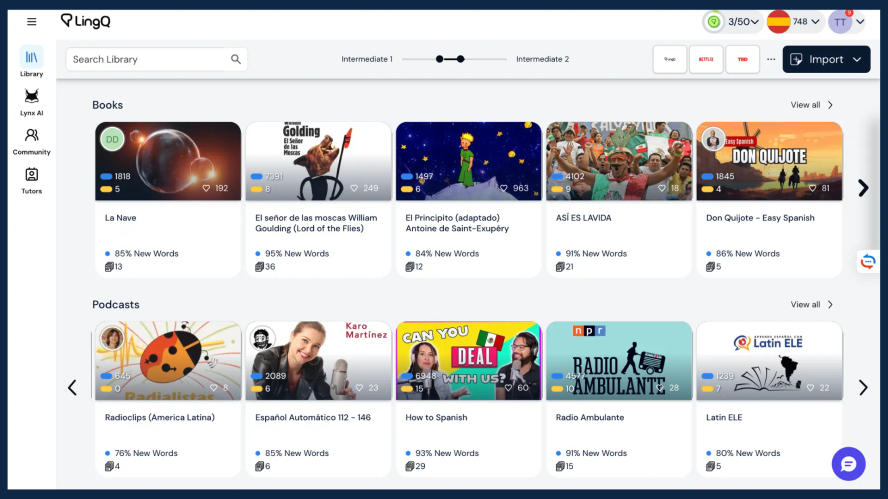
LingQ’s goal is to encourage independent language learning. Follow your curiosity while building consistent learning habits. Most of my time as a language learner is spent listening and reading on LingQ.
I can explore and import new content, but I can also emphasize repetition through vocabulary review. LingQ supports curiosity-driven exploration, but provides the infrastructure for structure and consistency.

How Much Freedom Should Independent Learners Have?
Successful lifelong learners need to be curious and motivated. But too much freedom can be a burden. Without structure, a learner can drift or plateau.
Effective independent lifelong learning requires:
- Freedom to explore topics of genuine interest
- Consistent, simple routines
- Goals that provide direction, but don’t limit exploration
The most successful lifelong learners remain curious, but also build habits that keep them moving forward.
FAQs
What is independent lifelong learning?
It’s the process of continuously developing knowledge and skills through self-directed study.
Why is independent lifelong learning important today?
Faced with rapid technological change, we constantly need to update or acquire new skills.
What is grazing learning?
Grazing learning involves exploring a wide range of material rather than studying in a strict sequence.
How do curiosity and discipline work together in learning?
Curiosity motivates exploration and discovery, while discipline ensures repetition and reinforcement.
Can language learning support lifelong learning habits?
Yes. Language learning encourages curiosity, cultural exploration, and consistent practice. The framework for independent lifelong learning directly applies to languages.


5 comments on “Effective Independent Lifelong Learning”
Comments are closed.
Are you familiar with Sugata Mitra’s work? He has the kind of big picture, blue sky thinking that has the power to shake up the education system. Not without controversy of course, but we are talking about change after all!
http://www.ted.com/talks/sugata_mitra_shows_how_kids_teach_themselves?language=en
Great article Steve Kaufmann!
I like how you pointed out how you learned so many languages through independent learning while in your 60’s! You really put me to shame–haha!
It really goes to show how much we can truly learn if we put our minds to it!
Great article. I have being an ESL teacher for a good 30 years and I find the language learning industry one of the most stagnant. Concepts that you talk about above such as grazing learning have not really made it to the classrooms. Other than some of the major players in the ESL industry (like Rosetta Stone, http://www.spokenenglishpractice.com, British Council) a very few others have even invested in proper websites to connect with new language learners. I completely agree with Olly that the next generation of entrepreneurs should look at this space, because a lot of disruption needs to take place.
You’ve provided a great summary here, very well comprehensible also for non-linguists. Thank you and happy English Language Day!
It really goes to show how much we can truly learn if we put our minds to it!